

The VGE Network
Van Gogh Museum, Amsterdam, The Netherlands
The Van Gogh Museum in Amsterdam houses the world’s largest collection of Vincent van Gogh’s paintings, drawings and letters. The permanent collection is designed thematically and chronologically, and shows work of the artist’s contemporaries and friends in addition to Van Gogh’s masterpieces.


Van Gogh House Drenthe, Veenoord, The Netherlands
In the autumn of 1883 Van Gogh spent three months in the northern province of Drenthe. The landscape left a permanent impression on the artist and he made several paintings and sketches in this period. The room where Van Gogh stayed can be visited in the Van Gogh House in Nieuw-Amsterdam/Veenoord. Through stories and new audio and visual presentations the guides will bring you back to 1883.
The tavern of the original accommodation is now an exhibition space where you discover more about the local history of the moors, the letters Van Gogh wrote in Drenthe and other artists that inspired him.

Van Gogh Village Nuenen, The Netherlands
Vincent van Gogh lived in Nuenen for two years (from December 1883 until November 1885). The artist produced a quarter of all his works in Nuenen. He drew and painted mostly weavers and peasants in the fields but also went out regularly to capture the surroundings. His first masterpiece The Potato Eaters was produced here. Nuenen can be seen as an outdoor museum with 24 buildings and locations in the countryside that have a direct link with Van Gogh’s work and stay. You will get to learn about Van Gogh as a person and follow his development as a painter in the Vincentre. Modern audio-visual techniques will make you think you are back in the time of Brabant’s most famous artist.

Dordrechts Museum, The Netherlands
As one of the oldest fine art museums in the Netherlands, Dordrechts Museum is home to an exceptional collection spanning six centuries of Dutch art. Dordrecht was the setting for one of the most formative chapters in Vincent van Gogh's life. In 1877, at the age of twenty-four, Vincent spent four months in the city searching for his future. Working in a bookshop, reading extensively, visiting the museum and wandering the streets and surrounding countryside, he was still years away from becoming an artist. Yet his letters from this period already reveal the themes that would shape his life and work: spirituality, compassion, nature and the search for meaning.

Kröller-Müller Museum, Otterlo, The Netherlands
The Kröller-Müller Museum boasts the second-largest Van Gogh collection in the world, compiled by Helene Kröller-Müller in the period 1908-1929: almost 90 paintings and over 180 drawings. The Van Gogh Gallery displays varying selections of about 40 works by Vincent van Gogh. Furthermore, there are masterpieces by modern masters such as Claude Monet, Georges Seurat, Pablo Picasso and Piet Mondriaan. In the sculpture garden, one of the largest in Europe, visitors can enjoy both sculptures and nature.

Drents Museum, Assen, The Netherlands
Vincent van Gogh’s time in ‘the painter’s paradise of Drenthe’ played a vital role in his artistic development, for this is when he definitively decided to become a painter of peasant life. The painting The Peat Boat, on view as part of the Drents Museum’s permanent collection, portrays the gruelling labour of working in the peat bogs. The harshness of this life is expressed in the peat-cutters’ daily routine of carrying the peat and loading it on the barge for transportation to the big cities. On view in the museum alongside the Van Gogh are paintings by contemporaries who were inspired by Drenthe as the ‘last unspoiled region’ of the Netherlands.

Vincent van GoghHuis, Zundert, The Netherlands
The Vincent van GoghHuis stands on the spot where the artist was born. Reminders of Van Gogh’s youth and the influence it had on the life of the future artist are brought to life in this cultural centre. In addition to a permanent presentation ‘Vincent van Gogh – the roots of a master’, his influence on 20th and 21st century artists is portrayed in temporary exhibitions.

Van Gogh Etten-Leur, The Netherlands
In 1881, at the age of 28, Vincent van Gogh decided to dedicate his career to art. He settled in Etten-Leur, where he officially registered himself as an artist for the first time and obtained his first studio. Etten-Leur therefore plays an important role in Van Gogh’s early artistic development. The Van Gogh Experience, located in the atmospheric Van Gogh Church (where his father served as a minister for seven years), makes this period accessible to the public. Visitors gain insight into Vincent’s motivation, themes, and first steps as an artist. A replica of his first studio can also be visited.

Van Gogh National Park, The Netherlands
Van Gogh National Park is a unique area in North Brabant, where nature, cultural history, villages and cities come together in a living landscape. It is a landscape that deeply moved Vincent van Gogh during his youth and continued to inspire him throughout his life. Among the forests, heathlands and fields, he discovered the raw beauty of nature and the simplicity of rural life.
That same connection with the landscape forms the foundation of Van Gogh National Park today. Together, we are building a future in which nature and agriculture strengthen one another, and in which cultural heritage is not only protected but actively experienced.

Van Gogh House, Cuesmes, Belgium
La Maison du Marais is the name given to the house where Vincent van Gogh lived for a short period from 1879 to 1880. This former house in the Belgian mining district of the Bourinage contains an audiovisual presentation as well as a facsimile of the painting Les Bêcheurs (The Diggers) from the collection of the BAM, the Museum of Fine Arts in Mons.

La Maison du docteur Gachet, Auvers-sur-Oise, France
The House of Dr Gachet was one of the most important places for Van Gogh in Auvers-sur-Oise. Its unique position in its surroundings as well as in art history makes it an indispensable destination for those who wish to follow the painter’s steps, thoughts and inspiration in the village. In 2023, the house has been completely refurnished and brought back to the atmosphere it offered in 1890.

Van Gogh Roots, Auvers-sur-Oise, France
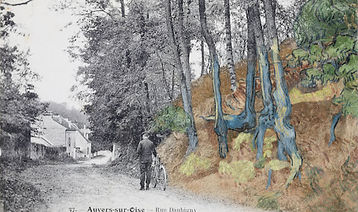
The Van Gogh Roots were discovered in 2020 by Dr Wouter van der Veen (Scientific Director of Institut Van Gogh) in Auvers-sur-Oise. This place reveals the location where Vincent van Gogh, over 130 years ago, painted his final masterpiece ‘Tree Roots’, just hours before he ended his life. On the scene you can find the tree trunks and roots growing on a hillside. In a private guided tour, you will get all the information on Van Gogh’s last day in the beautiful village, as well as the meaning of the painting and experience the exact place where Vincent’s brush touched the canvas for the very last time.
Asnières-sur-Seine, France
In 1887, while living in Paris, Vincent van Gogh frequently visited Asnières-sur-Seine. Inspired by its riverside setting along the Seine, its bridges, parks and cafés, he created around 30 paintings and drawings there. These works mark an important phase in his artistic development, as he experimented with brighter colours and Impressionist influences. Today, Asnières-sur-Seine recognises and celebrates its place in Van Gogh’s story as part of his artistic journey.

Saint-Paul-de-Mausole, Saint-Rémy-de-Provence, France
Vincent van Gogh received psychiatric treatment in the Saint-Paul-de-Mausole hospital in Saint-Rémy-de-Provence from May 1889 to May 1890. He was given his own studio, was much admired by the staff and was the only patient who was allowed to go outside the building. Van Gogh produced about 100 drawings and 150 paintings in and around the institution, including Irises, Wheatfield with Reaper, Starry Night and numerous paintings of olive trees and cypresses. The area surrounding this historic location, in particular the monastery and the Roman chapel, are just as the artists would have known them. His room has been reconstructed and can be visited.

The National Gallery, London, The UK
Located in London’s Trafalgar Square, the National Gallery is one of the greatest art galleries in the world and is free to visit for everyone. Founded by Parliament in 1824, it exists to bring people and paintings together. The Gallery houses the nation’s collection including works by Artemisia Gentileschi, Bellini, Cézanne, Degas, Leonardo, Monet, Raphael, Rembrandt, Renoir, Rubens, Titian, Turner, Van Dyck, Velázquez and Van Gogh.

The Royal Museum of Fine Arts Antwerp (KMSKA) is one of Belgium's leading art museums, housing an internationally renowned collection spanning from the fourteenth to the twentieth century. KMSKA presents both historic masterpieces and innovative approaches to art, research, and public engagement. KMSKA has a close connection to the artistic and cultural environment in which Vincent van Gogh developed as an artist. Antwerp played a significant role in his artistic formation. During his stay in the city between 1885 and 1886, Van Gogh attended classes at the Royal Academy of Fine Arts and encountered new artistic influences, including the work of Peter Paul Rubens and Japanese prints. His time in Antwerp marked an important transitional phase in his artistic development and helped lay the foundation for the vibrant use of colour that would later become one of the defining characteristics of his work.

Château d’Auvers, Auvers-sur-Oise, France
Featured in one of Van Gogh’s late masterpieces, Landscape at Twilight (F770), the Château d’Auvers is one of the defining historical monuments of the village where Van Gogh spent his last days. From October 2023, it will host an exhibition dedicated to Van Gogh’s stay in France from 1886 to 1890, with a focus on Auvers-sur-Oise, both digital and enriched with historical pieces and original artworks by fellow artists.

Fondation Vincent van Gogh Arles, France
Vincent van Gogh settled in Arles in 1888 because he wanted ‘a different light’. The period in Arles was the most productive in his life, with top works such as Sunflowers, The Yellow House and Bedroom in Arles. Van Gogh’s house was unfortunately destroyed in the Second World War. The Fondation offers a unique approach to Vincent van Gogh, namely by exploring, through the medium of temporary exhibitions, the resonance of his art and thinking with international artistic production today. Thanks to partnerships established with public and private collections, the Fondation presents one or more original canvases by Vincent van Gogh all year round, in company with a changing selection of works by internationally renowned contemporary artists. The Fondation also offers a wide range of in-house and extramural cultural events and activities: artist talks and podium discussions, symposia, film screenings, creative workshops and courses, performances and concerts, as well as guided tours and educational activities tailored to different publics.

Musée Estrine, Saint-Rémy-de-Provence, France
Alongside exhibitions of modern and contemporary artworks, Musée Estrine is also home to an educational centre dedicated to Vincent van Gogh’s art and life. The museum pays homage to the major works that Van Gogh created in Saint-Rémy-de-Provence, many of which have left their stamp on the history of art.

Van Gogh House, London, The UK
In 1873-1874, a 20-year-old Vincent van Gogh lived at 87 Hackford Road in Stockwell, London. During his long walks through the city and visits to cultural landmarks and galleries, Van Gogh became deeply inspired by British culture, artists, and writers. It was also here in London that Van Gogh fell in love for the first time with Eugenie Loyer, the 19 year old-daughter of his widowed landlady, Mrs. Ursula Loyer. Though this love was unrequited, Van Gogh’s time at Hackford Road is said to be some of the happiest of his life. The Van Gogh House London is conceived as an evolving opportunity to support emerging artists to make a living from their work in their lifetime - something Van Gogh himself was never able to achieve. The house is a space for research and learning; hosting contemporary exhibitions and artist residencies; alongside a programme of public tours, events and education activities with schools in the surrounding area and university courses.

Promotional Heritage Partner Organisations
NBTC Holland, The Netherlands
NBTC – the Netherlands Board of Tourism & Conventions – is the national destination management organisation of the Netherlands. Through strategic partnerships and international marketing, NBTC promotes Dutch cultural heritage, including the places that shaped Vincent van Gogh’s life and work. By collaborating with regional Van Gogh partners in Brabant and Drenthe, NBTC helps strengthen the visibility and sustainable development of the Netherlands’ Van Gogh heritage at home and abroad.

Van Gogh Sites Foundation, The Netherlands
The Van Gogh Sites Foundation is the regional heritage and tourism initiative that highlights Vincent van Gogh’s deep roots in the province of North Brabant, where he was born, raised, and developed his early artistic identity. The initiative promotes the many locations, landscapes, monuments, and museums connected to his life and work, inviting visitors to follow in his footsteps in places such as Zundert, Etten-Leur, and Nuenen and experience the landscapes that inspired his art. The Van Gogh Sites Foundation also collaborates with Van Gogh National Park and European Van Gogh partners to preserve, share, and celebrate his Brabant legacy.

Tourist Office Intercommunal Alpilles en Provence, Saint-Rémy-de-Provence, France
The Office de Tourisme Intercommunal Alpilles en Provence in Saint-Rémy-de-Provence promotes the cultural and natural heritage of the Alpilles region and supports visitors in discovering its rich history and attractions. Saint-Rémy-de-Provence is especially significant in Vincent van Gogh’s life: he lived and created many important works there between May 1889 and May 1890, while staying at the Monastery of Saint-Paul de Mausole — a period marked by some of his most celebrated paintings, including The Starry Night and numerous landscapes of olive trees and fields. The tourist office provides information, guides and routes related to Van Gogh’s life and artistic legacy in the area, helping visitors explore the places where he lived, worked and found inspiration during this pivotal chapter of his career.

Marketing Drenthe, The Netherlands
Marketing Drenthe is the regional destination marketing organisation for the province of Drenthe, dedicated to promoting the area’s tourism, culture and heritage. It plays an active role in the “Van Gogh Drenthe” initiative, collaborating with local governments, cultural institutions such as the Drents Museum, and other partners to make Vincent van Gogh’s time in Drenthe more visible and compelling for visitors and residents. Through marketing, storytelling and project support, Marketing Drenthe helps highlight places associated with Van Gogh’s stay in Drenthe and connects his legacy to the province’s broader cultural tourism offering.

Mons Region Tourist Office, Belgium
Mons Region Tourist Office is the official tourism organisation for the Mons region in Wallonia (Belgium), promoting local culture, heritage and visitor experiences. The region is historically significant in Vincent van Gogh’s life: from December 1878 to October 1880 he lived and worked in the Mons-Borinage area, including in Wasmes and Cuesmes, where he made his earliest drawings and began his transformation into a professional artist. Today Visit Mons highlights this legacy, including the Van Gogh House museum and related historic sites, offering visitors ways to explore the places where Van Gogh lived and developed as an artist.

Research and Educational Partners
Van Gogh Academy, Auvers-sur-Oise, France
The Van Gogh Academy is an international non-profit organisation dedicated to deepening and sharing knowledge about Vincent van Gogh’s life and art through research, education and immersive experiences. It offers expert-led courses, lectures, cultural gatherings and guided explorations that follow Van Gogh’s footsteps and illuminate his techniques, inspirations and artistic development. Based in Auvers-sur-Oise — where Van Gogh spent his final months and created many important works — the Academy strives to preserve and enliven his legacy by connecting people more closely with the places and contexts that shaped his creative journey.

Amsterdam Business School, University of Amsterdam, The Netherlands
The Amsterdam Business School is one of the Netherlands' leading business schools, preparing the next generation of leaders through innovative, research-driven education. Within its MSc Entrepreneurship and Management in the Creative Industries programme, the Strategies in Art & Entertainment course challenges students to explore the complex relationship between art, culture, business, and innovation. Our partnership brings Vincent van Gogh's legacy into the classroom through a unique live case. Every year, students work directly with Van Gogh Europe, applying strategic thinking and entrepreneurial approaches to develop innovative ideas that support our mission of making Vincent van Gogh's European cultural heritage accessible, engaging, and relevant for future generations. They present practical concepts and business initiatives that balance cultural impact with sustainable development.

Institut Van Gogh, Auvers-sur-Oise, France
The Institut Van Gogh is a non-profit organisation based in Auvers-sur-Oise, France, dedicated to preserving and promoting the memory, heritage and context of Vincent van Gogh’s final months in the town where he lived, worked and created many of his last masterpieces in 1890.
Founded in 1987, the Institut Van Gogh supports the conservation of the historic Auberge Ravoux and Van Gogh’s room, helps protect the landscapes that inspired his last works, fosters research on his life and art, and organises cultural initiatives that bring his legacy to life for visitors and scholars alike.
